
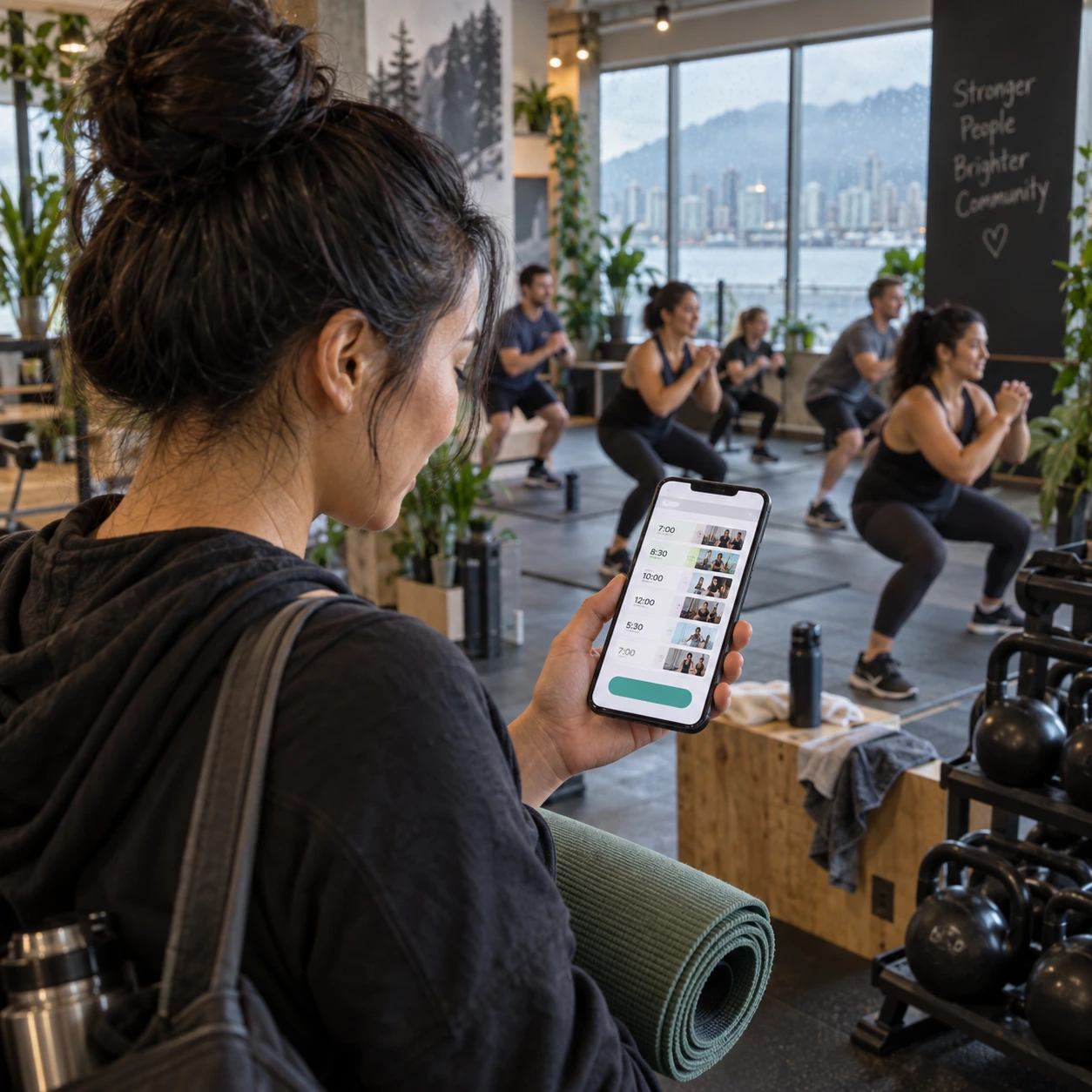
January hits, the phone starts ringing, and your website is the one part of the operation that can't keep up. Fitness website design in Metro Vancouver comes down to three things, and none of them are aesthetic: can a prospect see the timetable, see the price, and book a first session without emailing anyone? Most gym and studio sites fail at least one. Here's what a site actually needs, what it costs, and how it fits the booking platform you already pay for.
What makes fitness website design different from any other small business site
A fitness website isn't a brochure. It's a conversion surface for a recurring-revenue business with live inventory, because a class at 6:15 on Thursday is a seat that either sells or doesn't. That single fact changes what the site has to do, and it's why a generic small business template struggles here. If the brochure-versus-lead-generation distinction is new to you, we've written about which one a BC business needs.
Three constraints follow from it. The first is mobile. Your traffic is people standing in a kitchen or sitting on a bus, and Statistics Canada's 2022 Canadian Internet Use Survey put mobile data plan access at 84 per cent of Canadians. We won't relitigate the case for mobile-first design here, but for a studio it's not a preference, it's the whole channel.
The second is that your schedule changes weekly, so the site has to pull it rather than store it. The third is that you already run a booking platform, and the website's job is to hand off to it cleanly, not replace it. Close to four in five studios who come to us arrive with a template site they've outgrown on exactly these three points.
The pages and features every gym website needs
Eight things. If your site has all eight, you're ahead of nearly every independent studio in the region.
- A timetable that reads on a phone. This is the single most requested page on any fitness site. Pull it live from your booking platform so it never goes stale, and make sure it's legible without pinching.
- A trial or intro offer above the fold. First-time visitors aren't buying a membership, they're buying one class. Put the offer where a thumb lands. Moving the timetable and trial offer above the fold roughly doubled trial sign-ups for a North Shore studio we rebuilt.
- Transparent membership pricing. Hiding prices doesn't create enquiries, it creates bounces. List the tiers, the drop-in rate and the commitment terms plainly.
- A book-now path in two taps or fewer. Count them on your own site right now. Home to schedule to booking is fine. Anything longer leaks.
- A real coach and instructor page. People choose studios because of people. Names, faces, qualifications, and which classes each one teaches.
- Location, parking and transit detail per site. In Metro Vancouver this is genuinely decisive. Nearest SkyTrain station, whether street parking is metered, how to find the door.
- Photography of your actual space. Covered below, and it matters more than the layout.
- Google reviews pulled through. Live, not screenshotted, so social proof updates itself.
That list is the requirements brief. Where studios usually lose sign-ups is between items four and five, which is the same drop-off pattern we cover in conversion rate optimisation for BC service websites.
Photography, brand and why most gym websites look the same

Open five gym websites and you'll see the same four stock photos: the chalked hands, the kettlebell silhouette, the woman mid-lunge in a gym that is nowhere near you. Prospects have learned to read stock imagery as "this could be anywhere", which is the opposite of what a local studio needs to communicate.
Shooting your own space is cheaper than owners expect. A half-day session in Metro Vancouver typically runs between $900 and $1,600 and produces enough for a full site plus a year of social. Brief it properly: the empty room in morning light, the equipment in honest condition, real members with written consent, coaches in the middle of coaching rather than posed, and the entrance from the street so people can find you.
One thing worth knowing before you plan the shoot. The Fitness Industry Council of Canada's State of the Industry findings reported that data from over 150,000 check-ins, collected by Fliip, showed the 40 to 64 age group spends the most in gyms. Most gym photography is aimed at people twenty years younger than the members who actually pay the bills.
“the 40-64 year old demographic has more disposable income”
Gabriel Hardy, Executive Director, Fitness Industry Council of Canada
Hardy went on to note that the same group is heavily focused on physical activity for health, which is a different message from the aspirational one most fitness sites lead with. Tie the imagery to a colour and type system that also runs across your signage and printed schedule, and the whole thing starts to read as one business. Our guide to choosing fonts and colours that convert covers the mechanics, and brand design is where we take it further when a studio wants the full system.
Booking, memberships and the software your website has to live with
Roughly two thirds of the studios we build for already pay for Mindbody, Wellness Living, Glofox, Punchpass or something similar before we start. Good. Replacing it isn't the job, and any studio that suggests otherwise is selling you a second problem. Here's the honest division of labour.
| Your booking platform handles | Your website has to handle |
|---|---|
| Class capacity, waitlists and cancellations | Getting someone to the booking screen in two taps |
| Membership billing and renewals | Explaining the tiers before anyone clicks |
| Client records and attendance history | Convincing a stranger you're worth the trial |
| Staff scheduling and payroll | Showing who teaches what, with a face |
| The transaction | The decision that comes before it |
On the integration itself, you're choosing between an embedded schedule and a deep link out to the platform. Embeds keep people on your site but are the most common thing that breaks on a narrow screen, so test them on a real phone before launch, not in a browser window you've dragged narrow. Deep links are more reliable and cost you a little branding continuity. Neither is wrong. We go through the general mechanics in booking and scheduling features every Vancouver service website should have, and if you're selling memberships directly rather than through a platform, recurring billing on Canadian websites covers the tax and UX side.
Do you need a website if you have a personal trainer profile and Instagram?
Yes, and the reason isn't vanity. A platform profile and a social account are rented ground. You don't own the enquiry, you don't own the client list, and you can't be found by someone searching "personal trainer North Vancouver" unless the platform decides to surface you. A personal trainer website changes all three, and it's increasingly what AI answer engines cite when someone asks for a recommendation.
For a trainer working alone, four pages is enough:
- Home. Who you train, where, and a booking link. Nothing else above the fold.
- Services and rates. Session types, block pricing, what a first session involves.
- About. Certifications, your actual approach, and a photo taken this decade.
- Contact and booking. One form, one calendar, one phone number.
That's a build you can stand up quickly and grow into. It also gives you somewhere to send people from Instagram that doesn't disappear when a platform changes its rules.
Getting found: local search for gyms and studios in Metro Vancouver
Fitness is one of the most local search categories there is, because nobody drives across the region for a 6am class. The local pack is where most of the discovery happens, so your Google Business Profile does as much work as your homepage does. Our Google Business Profile guide for BC service businesses covers setup, and the broader discipline sits in local SEO for Vancouver small businesses.
Three things specific to multi-location studios. Give each site its own page with its own address, hours and photos, rather than one page listing three locations. Mark those pages up with LocalBusiness structured data so Google can read the details it needs. And write in the language people search with, so Burnaby, New Westminster and North Vancouver by name rather than "the Lower Mainland". If you're in the eastern suburbs, our web design in Burnaby and web design in Surrey pages cover how we handle that geography.
What a fitness website costs and how long it takes to build
For a single-location studio with an embedded schedule, real photography and clear membership pricing, our builds have sat between $6,500 and $18,000 and taken six to ten weeks. A solo trainer's four-page site finishes in about three weeks.
Four things move the number. How many locations you have, since each one needs its own page and its own local structure. Whether the schedule is embedded or custom-built. Whether photography is included or you already have usable images. And whether memberships are sold on the site or handed off to your platform. That last one is the biggest swing.
If the budget is tight, start with the timetable, the trial offer and the booking path, then add the rest. That's the sequence we recommend in affordable web design in Vancouver. Studios often find it useful to look at how we've handled the same problem for other hands-on local businesses, which is the ground covered in our piece on web design for trades businesses in Metro Vancouver. The full scope of what we do sits on our web design service page.
Frequently Asked Questions
What should a gym website include?
A mobile-readable class timetable, a visible trial offer, transparent membership pricing, a booking path of two taps or fewer, a coach page, location and parking detail, photography of your real space, and live Google reviews. Those eight cover almost every reason a prospect leaves without booking.
How much does a fitness website cost in Canada?
A single-location studio site with an embedded schedule and real photography generally falls in the mid four figures to high five figures, depending on location count, photography and whether memberships are sold on-site. A solo trainer's four-page site sits well below that. Get a scoped quote rather than trusting a range.
Do I need a website if I use Mindbody or Wellness Living?
Yes. Booking platforms handle the transaction, not the decision that comes before it. Your website is where someone decides you're worth trying, and it's also the only part of your presence that ranks locally and can be cited by search and AI answers.
What is the best platform for a fitness studio website?
The one that integrates cleanly with the booking system you already run and lets you update the site yourself. We build most studio sites in Webflow for that reason, but the platform matters far less than whether the timetable, pricing and booking path work on a phone.
Does a personal trainer need their own website?
If you want to own your enquiries and rank for local searches, yes. A profile on someone else's platform can be changed or removed without your say. Four pages is enough to start: home, services and rates, about, and contact.
Come back to the three-part test. Can a prospect see the timetable, see the price, and book a first session without speaking to anyone? Fix those, then work through the eight requirements in order, then worry about how it looks. The studios that fill classes in January aren't the ones with the prettiest sites. They're the ones where booking a trial takes fifteen seconds on a phone.
We build websites for Metro Vancouver service businesses, gyms and studios among them, with the timetables, booking paths and local structure that actually fill classes.