
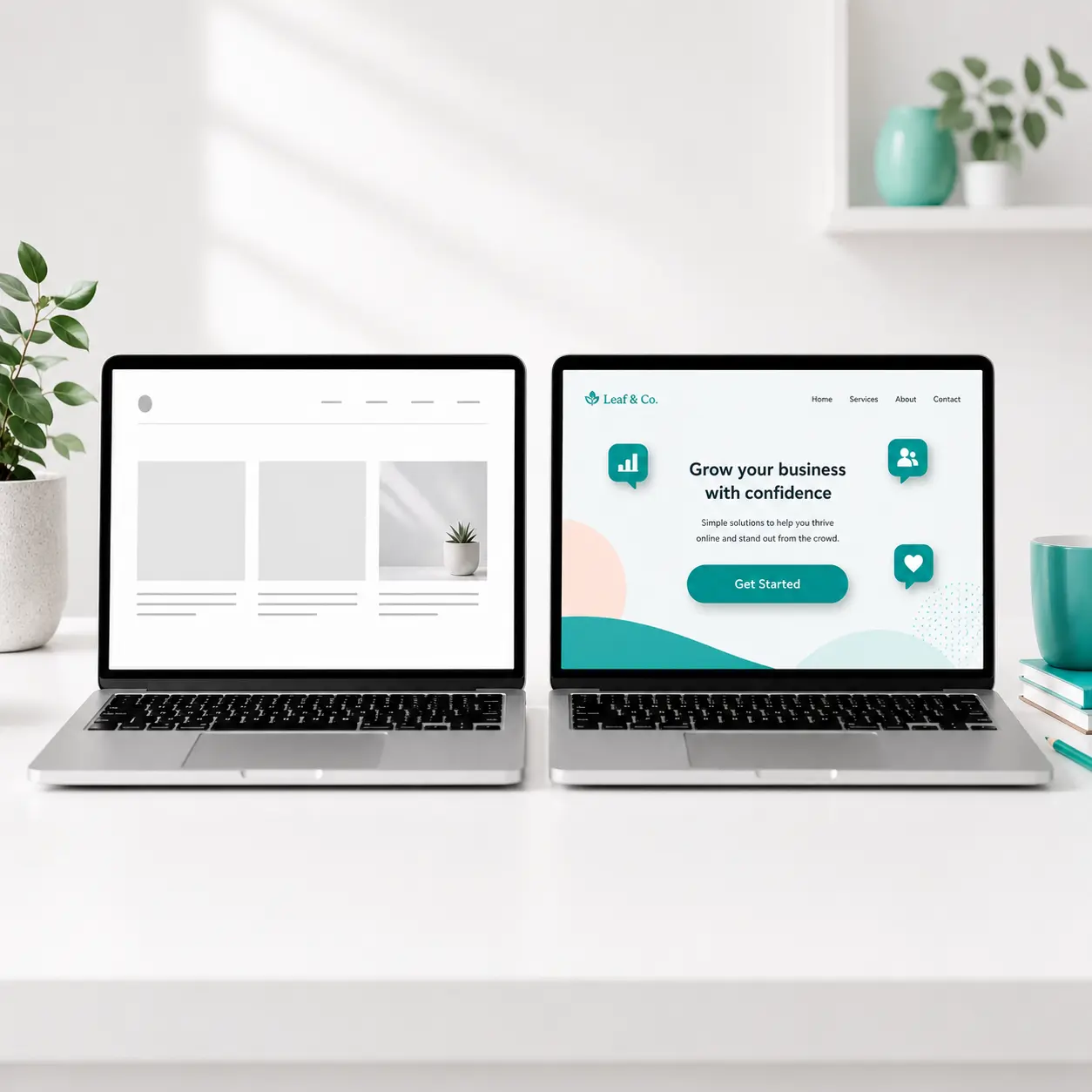
Most BC businesses don't need the most expensive website. They need the right type. A lead generation website is built to turn visitors into enquiries, while a brochure website simply presents your business through a handful of static pages. Both are legitimate, and the wrong one wastes money two ways: overbuilding for a business that runs on word of mouth, or underbuilding for one that lives on inbound demand. This guide gives you a clear framework for choosing, with honest pricing and real Lower Mainland examples.
Brochure Website vs Lead Generation Website at a Glance
Here's the short version. A brochure website presents your business through a few static pages such as home, about, services, and contact, while a lead generation website is built to convert visitors into enquiries through clear calls to action, purpose-built landing pages, and conversion tracking. Which one you need comes down to how your business actually wins work, not which sounds more impressive.
The table below compares the two side by side. If you read only one part of this article, read this.
| Website Type | What It Does | Typical Pages | Best For | Rough Investment (CAD) |
|---|---|---|---|---|
| Brochure website | Presents your business through static, informational pages | Home, About, Services, Contact | Referral-driven businesses that need a credible presence | $1,500 to $4,000 |
| Lead generation website | Turns visitors into enquiries through CTAs, landing pages, forms, and tracking | Home, service and landing pages, booking or enquiry forms, blog | Businesses that depend on inbound enquiries or run paid ads | $4,500 to $12,000 |
Those ranges reflect what we see across the Lower Mainland market, including our own Burnaby and Vancouver builds. They move with complexity, content volume, and how much custom design and integration a project calls for.
What Is a Brochure Website?
A brochure website is the online equivalent of a printed company brochure. It tells visitors who you are, what you offer, and how to reach you, and then it largely leaves them to it. It's static by design, which is both its strength and its ceiling.
A typical brochure site includes:
- A homepage that introduces the business and sets the tone.
- An about page covering your story, your team, and your credibility.
- A services or products page describing what you do.
- A contact page with a form, phone number, and location.
Its strengths are real. A brochure site is fast to build, affordable, and gives you a professional presence you can point people to. For a business with steady work already coming in, that's often enough: it says you're established and answers the basic questions.
The limits are just as real. A brochure site is passive. It offers few paths to act beyond reading, rarely captures information you can follow up on, and is usually built without the tracking that would tell you whether it's working. If a visitor lands, reads, and leaves, you'll never know. For a business that needs the website to bring in work, that's a problem.
A brochure website genuinely suits established businesses that win work through referrals, repeat clients, or relationships, and that simply need a credible online home. We'll come back to why it's sometimes the smarter spend.
What Is a Lead Generation Website?
A lead generation website is built to do a job: convert visitors into enquiries, bookings, or sales. Where a brochure site informs, a lead generation site is engineered around a path that guides visitors toward acting. Every page has a purpose, and that purpose is measured.
A conversion-focused build typically includes:
- Clear calls to action on every page, so the next step is never in doubt.
- Purpose-built landing pages that match what specific visitors are searching for.
- Booking or enquiry forms placed where intent is highest, not buried on a contact page.
- Tracking and analytics that show where enquiries come from and where visitors drop off.
- Fast load times, because slow pages quietly cost you conversions.
- An SEO structure that helps the right people find you in the first place.
This suits any business that relies on inbound demand to grow: trades booking jobs, clinics filling appointments, consultants generating qualified leads, or anyone spending on ads who needs those clicks to convert. The extra investment pays off because the site stops being a digital business card and becomes a channel. When a visitor can find you, understand you, and enquire in seconds, the website earns its cost back in work won. You can see how we approach this on our web design services page.
The Real Differences That Affect Your Results
The labels matter less than what each type changes about your outcomes. These are the differences that actually move the needle.
- Primary goal. A brochure site optimises for presence; a lead generation site optimises for enquiries. That single difference shapes every decision that follows, from layout to copy to where the buttons go.
- Site structure. A brochure site is organised around your business: here's us, here's what we offer. A lead generation site is organised around visitor journeys, walking someone from their need to an enquiry without friction.
- Calls to action. On a brochure site, the call to action is often a single contact link in the menu. On a lead generation site, action is invited continuously and contextually, so visitors are never more than a glance away from the next step.
- Measurement. This is where results quietly diverge. A brochure site usually can't tell you what's working; a lead generation site is wired for analytics from day one, so you see what converts and improve it. Across the lead generation sites we shipped in 2025, the average enquiry rate landed near 4.8 per cent, against roughly 2 per cent on the brochure sites we replaced. You can only improve what you can see.
- Ongoing investment. A brochure site can sit largely untouched for a year. A lead generation site rewards ongoing work: fresh content, SEO, and steady optimisation compound over time. It asks more of you and gives more back.
Which One Does Your BC Business Need?

Forget the labels for a moment and answer a few honest questions. Your answers point clearly to one type or the other.
- How do you currently win work? If you rely on inbound enquiries from people who don't already know you, you need a site built to convert them. If almost all your work comes through referrals and repeat clients, a brochure presence may genuinely be enough.
- Are you running ads, or planning to? Paid traffic is wasted on a brochure site. If you're spending on Google or social ads, those clicks need a conversion-focused destination, or you're paying to send people to a dead end.
- What stage and budget are you at? A brand-new business steadying its footing has different needs from one ready to scale. Be honest about both where you are and where you're going in the next year.
Here's something we notice repeatedly. Roughly 6 in 10 of the owners who approach us asking for a simple website turn out, on closer inspection, to depend on inbound enquiries rather than referrals alone. They ask for a brochure site out of caution about cost, when what's actually holding back growth is the absence of a site that converts. The point isn't to upsell everyone, but to make sure the cheaper option is a real fit, not a false economy.
One example. A Burnaby trades client came to us with a three-page brochure site generating about 4 enquiries a month. After we rebuilt it as a lead generation site with dedicated service pages and a streamlined quote form, that rose to 19 within two months. Nothing changed except the website's job. Weighing this locally, our Burnaby web design work is built around exactly this conversion goal, and for budget-conscious builds, our affordable web design in Vancouver approach does the same at a lower entry point.
And to be clear: some businesses really do only need a brochure site. A solicitor with a full roster, a tradesperson booked out on referrals, a consultancy that grows by reputation. For them, paying for conversion infrastructure they won't use is the wrong call. Choosing the simpler option on purpose is legitimate, and often smart.
Can You Start With a Brochure Site and Upgrade Later?
Yes, and for some businesses it's the right sequence. If you're early, unsure of demand, and need to control spend, a brochure site now and a conversion-focused rebuild later is a reasonable path. The route usually looks like this.
- Add tracking first. Before changing anything, install analytics so you have a baseline. You can't measure the improvement without it.
- Identify your highest-intent pages. Work out which services or products actually bring in enquiries, and build conversion-focused landing pages for those first.
- Introduce clear calls to action. Add enquiry and booking paths throughout the site, placed where visitor intent is highest rather than only on the contact page.
- Strengthen the SEO structure. Rework page structure, titles, and content so the right people can find you, then let that traffic feed the new conversion paths.
- Optimise on real data. Once enquiries are flowing, use what the analytics show to refine the pages that convert and fix the ones that don't.
Be honest about the cost of doing it twice, though. In our experience, owners who start with a brochure site and rebuild for conversion within two years tend to spend 35 to 50 per cent more in total than those who build for growth once. If you already know you'll need a converting site within a year, building with that in mind from the start is usually cheaper overall. Where a rebuild is the right call, our website redesign services are built around exactly this upgrade route.
Frequently Asked Questions
Is a brochure website bad for SEO?
Not inherently. A well-built brochure site can rank perfectly well for your business name and a handful of core terms. The limitation is that brochure sites usually have little ongoing content and few pages targeting specific searches, so they tend to plateau. A lead generation site, with landing pages and a blog, generally has far more room to grow in search over time.
How much more does a lead generation website cost in Canada?
In the Lower Mainland, a brochure site typically runs $1,500 to $4,000 CAD, while a lead generation build usually falls between $4,500 and $12,000, depending on complexity, content, and integrations. The gap reflects the extra strategy, landing pages, forms, tracking, and SEO structure that go into a site built to convert. The right comparison isn't the sticker price, but the cost per enquiry the site produces.
Do I need a lead generation website if I get most of my work by referral?
Probably not, and that's a legitimate position. If referrals and repeat clients keep you busy, a brochure site that establishes credibility may be all you need. The question to ask is whether that referral flow is reliable enough for the future. If you want to reduce your dependence on it, a site built to generate enquiries is the way to start.
How long does it take to build each type?
A brochure build with us usually takes about 3 to 4 weeks, since the scope is contained and the pages are straightforward. A lead generation site generally runs 7 to 9 weeks, because it involves more strategy, custom landing pages, forms, and tracking setup. In both cases, the biggest variable is how quickly content and approvals come together on the client side.
The right website isn't the most expensive one, it's the one that matches how your business actually grows. If you're weighing a brochure site against a build that brings in enquiries, we'll give you a straight answer about which fits your goals and budget. See our Burnaby web design and affordable web design in Vancouver work, or read how we think about getting found in Google AI Overviews as part of the same local-visibility push.