
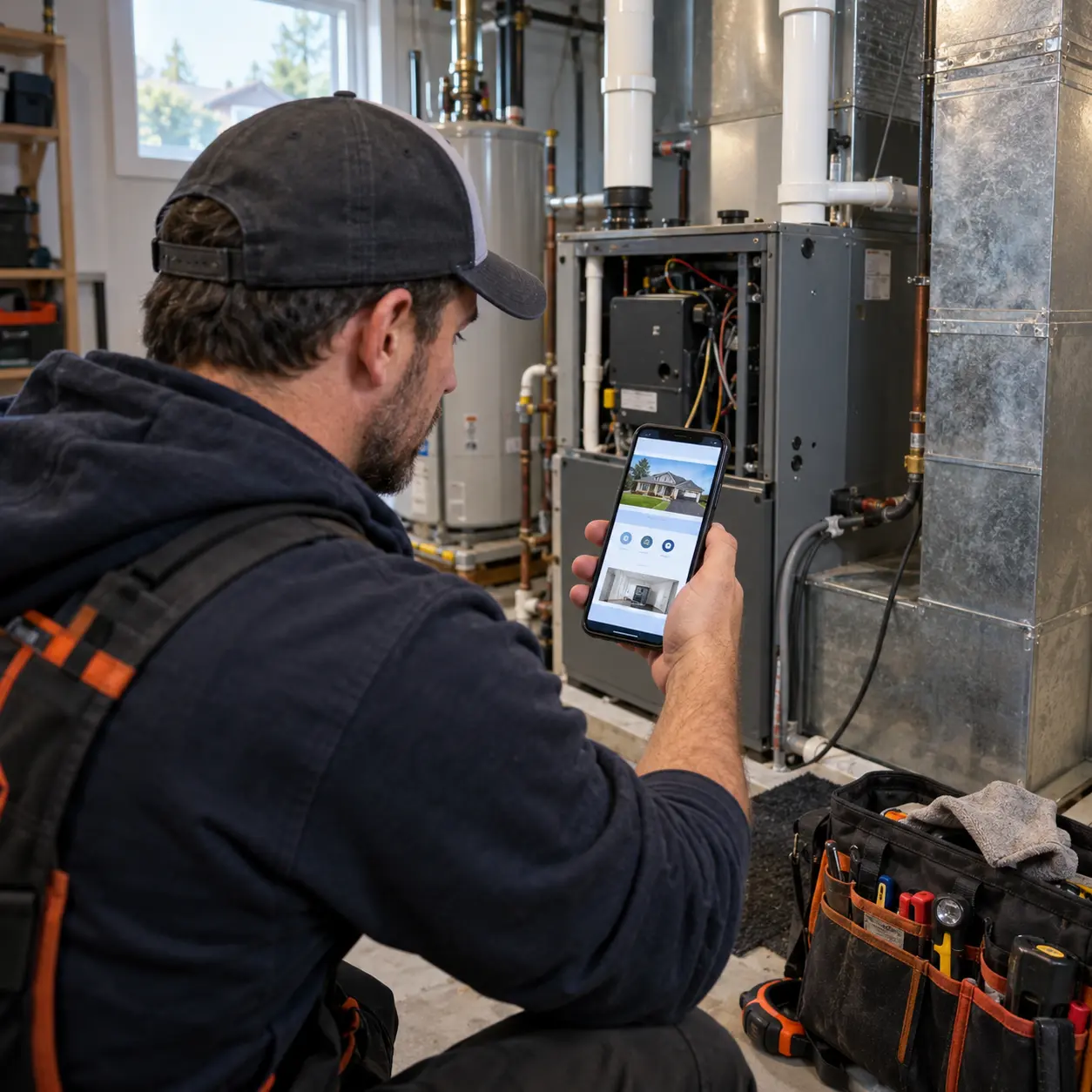
It's 7am, there's water coming through a Burnaby basement ceiling, and someone is standing in it holding a phone. They'll look at two or three results, pick whoever looks legitimate, and call. Contractor website design in Metro Vancouver is built for that twenty seconds and almost nothing else. Your site's job is to win that call. Here's what it takes, roughly what it costs, and what changes if you're an HVAC firm rather than a plumber.
What does contractor website design actually need?
A home services website has one job: turn an urgent phone search into a phone call. It does that through five things. A phone-first layout. A page for every service you sell. A page for every area you genuinely serve. Visible licence and insurance proof. And photographs of recent local work. Everything else is decoration.
That's the specification. Choosing who builds it is a separate question, and choosing a web design agency for a trades business answers that one, so this piece stays on what the site itself has to do. What follows: how customers actually find you, the five requirements, the phone-first details that win or lose the call, what's different for HVAC, honest costs, and a short handoff on getting found afterwards.
How customers actually find a plumber or electrician
Walk the real journey. Something breaks. The customer searches on a phone, usually with an urgency or neighbourhood word attached. They scan the map pack and the first two or three results. They call whoever looks legitimate and picks up. They do not read your about page. They do not compare three quotes. Roughly two thirds of the trades enquiries that reach us arrive from a phone, and a fair share arrive outside business hours.
Two consequences govern every decision later in this article. First, the site is judged in seconds on a small screen, which means the top of the page is the whole page. Second, the goal is a call, not a form submission, which sounds obvious and is the thing most trades sites get wrong.
Reviews sit inside that journey more than most owners realise. BrightLocal's Local Consumer Review Survey 2026 found that 97% of consumers read reviews for local businesses, and that 54% then go on to check the business's website after reading positive ones. That's a panel of 1,002 United States adults, so treat the exact figures as directional for Metro Vancouver, but the sequence holds: reviews send people to your site, and your site closes or loses them. The same survey found 47% won't use a business with fewer than 20 reviews at all.
“Reviews are stable, sticky, and more important than ever.”
Myles Anderson, Co-founder and CEO at BrightLocal
If you're still weighing whether the site should be a working tool or a digital business card, lead generation versus brochure websites makes the case better than we can here.
The five requirements of a trades website
- A page for every service. Why: drain cleaning and panel upgrades are separate searches. How: one page each, named the way customers say it.
- A page for every area you serve. Why: people search with a place name attached. How: a real page per municipality you genuinely cover, and none for the ones you don't.
- Licence and insurance proof, shown not claimed. Why: a number is verifiable and the word "certified" isn't. How: put your licence numbers and coverage on the page.
- Recent local work, photographed honestly. Why: a real job in a recognisable neighbourhood outperforms stock photography. How: the phone in your pocket is a sufficient camera.
- Emergency and after-hours clarity. Why: vagueness loses the job to whoever is specific. How: state what you cover, what hours, and what the call-out costs.
A page for every service you actually sell
This is the reason most trades sites rank for nothing. Drain cleaning, hot water tank replacement, panel upgrades, EV charger installation and furnace replacement are five separate searches by five different people. A bulleted list on one services page answers none of them. On a Surrey plumbing client, splitting a single list into eight service pages produced most of their new search traffic inside two quarters.
A page for every area you genuinely serve
The honest version of this matters. A page per municipality you actually cover, with a real reason to exist on it, works. Thirty invented city pages for places you'd never drive to is a liability: you'll take calls you can't service, and you'll get the reviews that come with that. If you want to see what a proper geography page looks like, web design in Burnaby and web design in Surrey are ours.
Licence, insurance and certification proof, shown not claimed
"Licensed and insured" is a phrase anyone can type. A licence number is a fact a customer can check, and Technical Safety BC's Find a Licensed Contractor directory is where they'd check it. Put your Technical Safety BC licence number, your WorkSafeBC coverage and any manufacturer certifications in plain text on the page rather than in a logo strip. Since we started doing this, clients report far fewer calls that open with "are you actually licensed".
Recent local work, photographed badly and honestly
A slightly crooked photo of a real furnace install in a real East Van basement beats a stock image of a smiling technician every time, because the customer is trying to work out whether you're real. Shoot before and after on the phone, note the neighbourhood, and post a dozen. It costs nothing and it's the most persuasive content on the site.
Emergency and after-hours clarity
Say what counts as an emergency, what hours you answer, what the call-out fee is, and how fast you typically arrive. Every vague site loses the job to the specific one, because the person standing in water is deciding between you in about four seconds.
The phone-first experience that wins the call
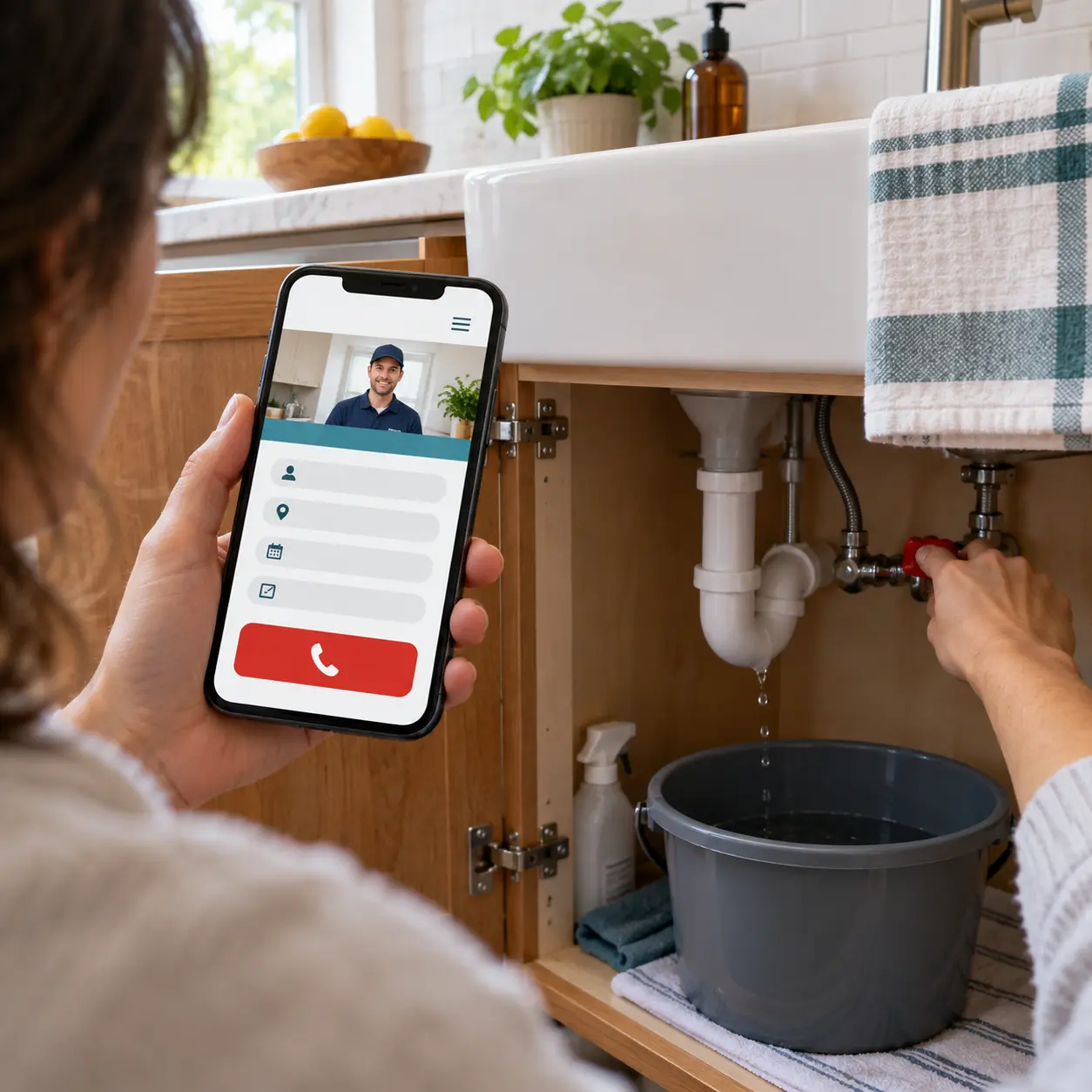
On the trades sites we've built, the tap-to-call button accounts for roughly four in five conversions. Everything below is in service of that one button.
| Wins the call | Loses the call |
|---|---|
| Tap-to-call button visible without scrolling, and it stays visible | Phone number in the footer only |
| Phone number as a real tel: link | Phone number baked into an image or a header graphic |
| Page loads on one bar of mobile data | A full-width hero video and six web fonts |
| Type large enough to read one-handed, outdoors | 13px grey text on a light grey background |
| A four-field form for non-urgent jobs | An eleven-field quote request with a required budget dropdown |
| Hours and service area stated near the top | "Serving the Lower Mainland and beyond" |
"Request a quote" as the only option is a conversion failure for urgent work. Nobody standing in a flooded basement fills in a form and waits. Offer the call first and the form as the fallback for the person planning a bathroom in six weeks. Booking software is a different tool for a different job, and booking and scheduling features covers when it's worth having.
We're not going to re-explain mobile design principles here, because mobile-first design already does that properly. What's trades-specific is the combination: tap-to-call, one-bar load speed, and one-handed reading in bad light. If you want the mechanics of finding where visitors drop off, conversion rate optimisation for BC service websites is the deeper read, and what makes a great small business website is the general baseline.
HVAC websites: what changes when demand is seasonal
An HVAC website sells two different things to two different customers, which is why it can't be a plumber's site with the words swapped. Emergency no-heat calls in January behave like plumbing. Furnace and heat pump replacements behave like a considered purchase, where the customer genuinely does compare three quotes over two weeks. The site has to serve both without letting either one win.
Four things follow from that. Your maintenance plan is a recurring revenue product and deserves its own page, priced, with what's included stated plainly. Your replacement pages need to carry more depth than an emergency page ever would, because someone is reading them properly. Indoor air quality is a distinct service cluster with its own searches and its own customer, not a bullet under "other services". And rebates are a real traffic driver in British Columbia.
On rebates, one rule. Do not state a programme's value, eligibility or existence on your own site. Provincial and utility incentive programmes change regularly, and an out-of-date rebate page is worse than no rebate page, because it costs the reader money and costs you the trust. Point at Better Homes BC and the relevant utility as the authority, say plainly that amounts must be checked there, and keep your own page to what you install and how the process works. If you can't commit to checking that page quarterly, don't build it.
Plumbers and electricians: where the emphasis shifts
For plumbers, the emergency share of the work is the highest of the three trades, so phone-first matters most and the service list is the longest. Drain cleaning, hot water tanks, leak detection, repiping, fixture installation and backflow testing are all searched individually, and each deserves a page.
For electricians, more of the work is planned than urgent. Panel upgrades and EV charger installation are growth categories with their own search demand and their own questions, and permit and inspection queries are a content opportunity nobody in the trade is serving well. The failure mode here is an electrician's site built as if every call is an outage, when most of the money is in scheduled work.
What does a trades website cost in Metro Vancouver?
Our trades builds have generally landed between roughly $4,500 and $16,000, with three to six weeks from start to launch. The variables: how many services, how many service areas, whether photography is needed, whether the old site's content can be salvaged, and whether you want to manage it yourself afterwards.
The comparison owners actually want is against the lead-fee bill, and it needs handling honestly. A website is a one-time build cost with a modest ongoing cost. A per-lead platform is a recurring cost that scales with the work you win. We're not going to publish anyone's per-lead pricing here, because those change and you should check them at the source. And we won't claim a website replaces paid lead generation. The honest version is that a site which ranks for your services and your areas reduces your dependence on those platforms over time, which is a slower and more durable claim.
| One-time build | Monthly lead fees |
|---|---|
| Paid once, then a small ongoing hosting and maintenance cost | Paid per lead, forever, whether or not you win the job |
| The asset and the enquiries belong to you | The relationship belongs to the platform |
| Improves as reviews and content accumulate | Cost per lead tends to rise as more firms bid |
| Slow to start, compounds over years | Works immediately, stops the day you stop paying |
For what's included and how we work, see our web design service, or affordable web design in Vancouver if budget is the constraint.
Getting found after the site is built
Three things matter and they're not this article's subject. Your Google Business Profile, fully filled in and kept current. Your business name, address and phone number identical everywhere they appear. And reviews, asked for consistently rather than in bursts, given that 47% of consumers won't consider a business with fewer than twenty of them.
That's the whole summary, deliberately. Local SEO beyond your Google Business Profile owns this discipline properly, and the Google Business Profile guide for BC service businesses owns the profile itself. Read those two and you've covered it.
Frequently Asked Questions
How much does a website cost for a contractor in Canada?
For a small Metro Vancouver trades firm, a properly built site generally runs from the mid four figures into the mid five figures, driven by how many services and service areas need their own pages. Add a modest monthly cost for hosting and maintenance, and budget for photography if you don't have usable job photos.
Do plumbers and electricians really need a website if they have a Google Business Profile?
Yes, because the profile and the site do different jobs. The profile gets you into the map pack; the site is where people check whether you're real, licensed and worth calling. BrightLocal's 2026 survey found 54% of consumers visit a business's website after reading positive reviews, so the profile sends traffic the site has to convert.
What pages should a plumbing or HVAC website have?
One page per service you actually sell, one page per area you genuinely serve, a page showing licence and insurance details, a gallery of recent local jobs, and a clear emergency or after-hours page. HVAC firms should add a maintenance plan page and separate pages for replacement work, which is a considered purchase rather than an urgent one.
How do I show my trade licence on my website?
Put the licence number itself in plain text, in the footer and on your about page, alongside your WorkSafeBC coverage and any manufacturer certifications. A number a customer can verify through Technical Safety BC's contractor directory is worth far more than the word "certified" or a badge graphic.
How long does it take to build a website for a trades business?
Three to six weeks is typical for a small firm, assuming you can supply a service list, your service areas, licence details and some job photos. The usual delay isn't the build. It's waiting on photos, which is why we suggest shooting a dozen jobs on your phone before the project starts.
Five requirements carry a trades site: a page per service, a page per area you genuinely serve, licence and insurance proof shown as numbers, recent local work photographed honestly, and emergency clarity. Underneath all of them is one reframe. For a home services firm, the website's job is to win a phone call in under twenty seconds, on a small screen, from someone who is having a bad morning. Design for that and the rest follows.
Parabolic Studio builds websites for Metro Vancouver trades and home service firms that need to be found and called. No brand exercise, no jargon, just a site that answers the phone.