
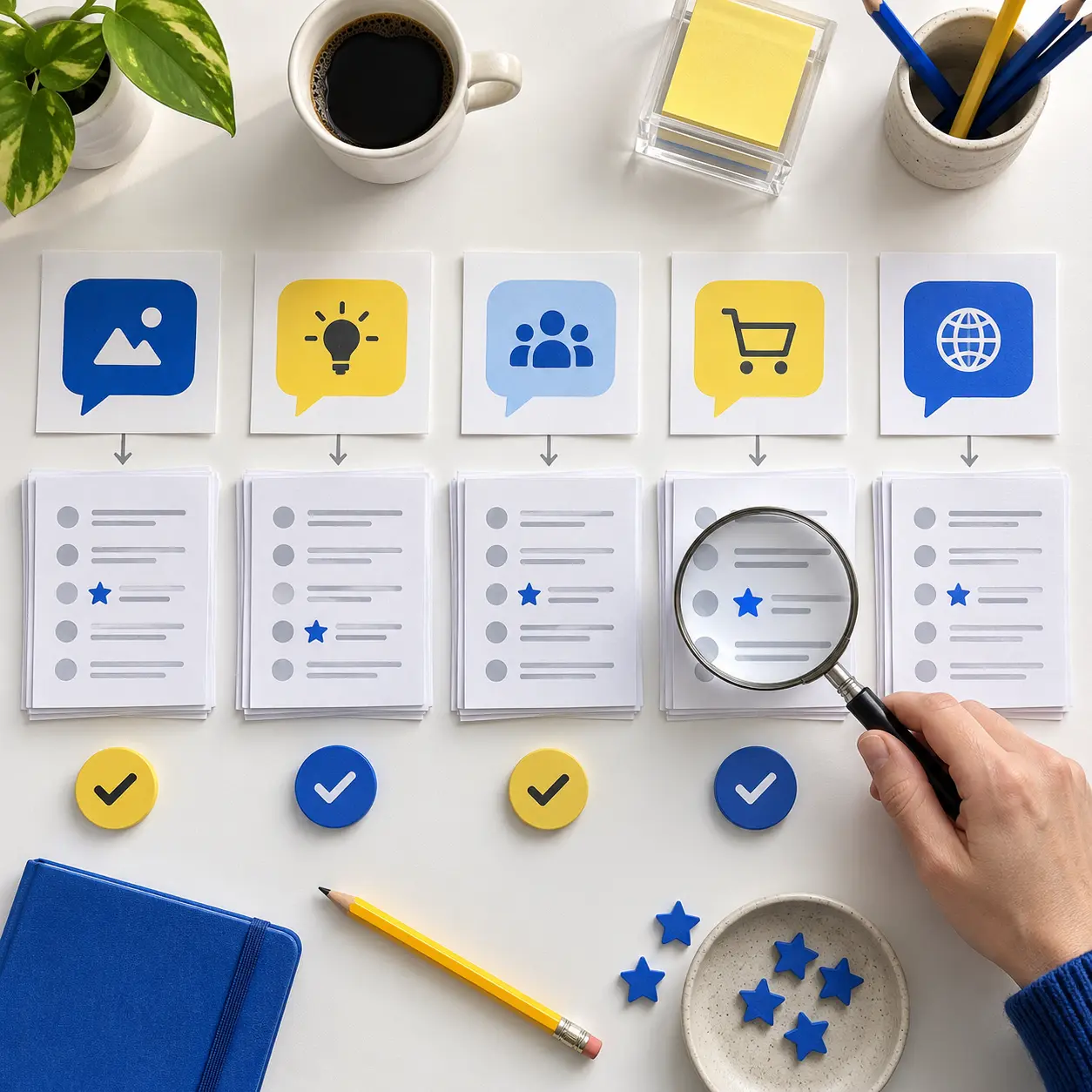
Someone asked ChatGPT for the best firm in your category, your name wasn't in the answer, and now you want to know what it actually says about you. Here's the short version. You can check brand visibility in ChatGPT yourself, free, in about an hour, by asking a fixed set of buyer questions, running each more than once in a clean session, and writing down what comes back. No tool required.
We're a services studio, not a software company, and we take no affiliate money here, so nothing below ends at a subscription. What follows: what visibility means on this surface, the five steps, what to record, how to read the result without fooling yourself, and what to do if it's bad.
What Brand Visibility in ChatGPT Actually Means
Brand visibility in ChatGPT is whether, and how, your business appears in ChatGPT's answers to the questions your buyers actually ask, across repeated runs of the same questions. It isn't a position on a list, because ChatGPT writes an answer rather than returning ranked results. There's nothing to be third in.
Three separate things are observable by hand, and they're worth keeping apart.
- Whether you're named at all. Does your business appear in the answer, in any form?
- Whether a page of yours is linked as a source. Being cited is rarer than being named, and happens for different reasons.
- How you're described. What the answer says you do, who it says you serve, and whether that's still true.
That third one is the one people skip, and the one a person catches better than any dashboard will. A dashboard reports a rate. A human reads the sentence and notices the company is described as doing work it stopped doing two years ago. We've stopped treating the count as the headline for that reason. For the underlying concept, we've covered what AI visibility is and how it's measured separately.
How to Check Your Brand's Visibility in ChatGPT in Five Steps
Work through these in order. About an hour the first time, roughly half that when you repeat it.
- Write ten to fifteen questions the way a buyer would ask them. Not your category label, and not your company name. Mix three kinds: the problem your buyer actually has, the category recommendation question, and the shortlist question naming your city or sector. Then write two or three direct questions about your company by name, kept in a separate group, because "does ChatGPT know us" and "does ChatGPT suggest us" are different questions.
- Start a clean session before you ask anything. Your signed-in account is not a neutral instrument. Look for two controls: a chat that stays out of your history, and a setting that stops saved memories and custom instructions shaping the answer. As of 17 September 2026, OpenAI's documentation describes a temporary chat where you pick Personalized or Unpersonalized before the first message, with Unpersonalized using no memory, custom instructions or plugins, and says the choice can't be changed once the conversation starts. Pick before you type.
- Ask each question three times. One answer is an anecdote. Three runs of the same question is the smallest thing you can honestly call a result. The same prompt genuinely can return different answers on different runs, and until you've seen the spread you don't know whether you're looking at a finding or at weather.
- Record what came back before you interpret any of it. Use the log in the next section. The discipline that matters isn't writing down the answer, which everybody does. It's writing down the conditions beside it, which almost nobody does, and which is what lets you compare this quarter to the next.
- Run the whole set again for two or three competitors. Without a comparison your result has no scale. Being named in two answers out of thirty means one thing if the market leader is named in twenty-eight, and something entirely different if nobody in your category is named at all. The second case isn't a visibility problem. It's an empty field, and it's an opportunity.
What you have at the end is a snapshot, dated, taken under conditions you wrote down, repeatable and comparable. That's all it is, and it's more than most people have.
On step three: across roughly forty client and prospect brands we've checked since early 2025, more than half the time the three runs didn't return the same set of named brands. The mechanism is documented. Horace He and Thinking Machines Lab, writing in September 2025, sampled 1,000 completions from one model at temperature 0, the setting meant to make output deterministic, and got 80 unique completions back.
“Reproducibility is a bedrock of scientific progress.”
Horace He, researcher, Thinking Machines Lab, Defeating Nondeterminism in LLM Inference
ChatGPT interface controls last checked against OpenAI's documentation on 17 September 2026. Menu names here change often; check the current wording before following step two to the letter.
What to Record When You Run the Check

One row per prompt run. A spreadsheet is fine. Seven columns, about as many as survives being read on a phone.
| Question asked | Run | Named? | Page cited | How you were described | Conditions | Date |
|---|---|---|---|---|---|---|
| Verbatim | 1, 2 or 3 | Yes or no | URL, or blank | A short note in your own words | Signed in or out, personalization on or off, mode, locale | Day you ran it |
The conditions column is the one people drop, and the one that makes the exercise repeatable. A log without conditions can't be compared to the same log next quarter, and comparison is the whole reason you're writing anything down. Six months from now nobody will remember whether you were signed in.
When the log is full, read it in this order: description notes first, cited pages second, count last. That's the reverse of what everyone does. The count feels like the answer and tells you the least, because alone it can't tell an invisible brand from a category nobody asks ChatGPT about. The description notes are where you'll find something you can fix on Monday.
How to Read the Result Without Fooling Yourself
Four things change what you saw, and none of them are your fault.
Repeat runs. A brand named in one run out of three isn't visible a third of the time. It's a brand you haven't sampled enough to say anything about. Three runs tells you whether there's variation. It doesn't give you something you could report, which is a separate question.
Signed-in state, saved memory and personalization. What you saw may reflect your own history rather than what a stranger gets. OpenAI's help documentation, revised within the month when we read it on 17 September 2026, states that if memory is enabled, ChatGPT may use relevant saved memories when rewriting a search query. Your account knows you run this business. A prospect's doesn't.
Mode. A quick reply and an answer built from live web queries are different products of the same box. The same documentation says ChatGPT may search the web automatically when a question would benefit from current information. Record which kind you got, or you're averaging two things.
Locale and language. That documentation also describes ChatGPT using an approximate location from your IP address, with device location sharing optional and off by default. For a Canadian business this moves the result more than people expect, and it's the condition teams most often forget.
One caution. Much of what circulates about how ChatGPT picks and weighs sources is third-party pattern analysis, not OpenAI, and whoever tells you should say so. On placement OpenAI is direct in its own documentation: results are ranked using multiple factors, and placement is not guaranteed.
| What you found | What it suggests | First thing to do |
|---|---|---|
| Not named at all, in any run | There probably isn't enough about your business anywhere to draw on. Check competitors first: if nobody is named, the category is the issue, not you. | Publish before you measure again. Confirm assistants can reach your site at all. |
| Named, but described wrongly or vaguely | An entity and corroboration problem. The sources being drawn on are stale, or they're somebody else's description of you rather than yours. | Find the stale sources. Fix what you control first, then third-party listings. |
| Named and cited correctly | The position is real today. It isn't a moat, and competitors are running this same check. | Keep the log. Repeat next quarter and watch the description, not the count. |
The described-wrongly row is the common one, under-reported because no dashboard flags it. Close to a third of the brands we checked had something out of date in ChatGPT's description of them: an old service line, a city they'd left, a founder who'd moved on. That isn't peculiar to us. In the EBU and BBC study published in October 2025, journalists at 22 public broadcasters, CBC-Radio Canada among them, assessed more than 3,000 assistant answers: 45% had at least one significant issue, and 20% contained major accuracy problems including outdated information.
Running this for a client before a pitch? The log licenses "across fifteen questions run three times each on 17 September, signed out, personalization off, in Canadian English, you were named twice." It doesn't license "you don't show up in ChatGPT."
What to Do When ChatGPT Gets Your Business Wrong
Each of the three outcomes is evidence of a different thing.
Absent usually means there isn't enough material about your business, on your site and elsewhere, for an assistant to have formed a view. That's a publishing problem before it's a measurement problem. Check the access layer too, since a site an assistant can't crawl can't be drawn from: llms.txt explained covers that.
Described wrongly is an entity and corroboration problem. The fix is structural and editorial rather than promotional: make the correct description of your business the easiest and most authoritative one to find, in enough places that it outweighs the stale ones. That's generative engine optimization as a discipline, our GEO service as the version we run for clients, and answer engine optimization for the content side.
Named and cited correctly means holding the position while competitors notice. How to rank in ChatGPT is the engine-specific execution, our complete ChatGPT SEO guide the broader picture, and getting ChatGPT to recommend your business the buyer-intent version. For Google's answer surface, AI Overviews; for why the ranking metaphor you arrived with stops applying, GEO versus SEO. To hand the whole thing over, our AI search optimization service.
None of it is a reason to panic about timing, but the audience is real. Pew Research Center's June 2026 survey of 5,119 US adults found about half now use AI chatbots, 44% use ChatGPT, up from 34% a year earlier, and six in ten read AI summaries above search results.
When to Stop Checking by Hand
Three situations, not three products.
- The prompt set outgrew the hour. Nobody is realistically running fifty questions three times each every month, so it stops getting run, and an unrun check is worth nothing.
- More than one person needs the same numbers. Two people checking by hand produce two incompatible logs. Software solves consistency problems well.
- Somebody is accountable for the trend. Not the snapshot. Explaining movement over months needs a record nobody compiled from memory.
Here's the part against our own interest: if you're a small business checking once a quarter, the manual method gives you the same signal as a subscription. That isn't false modesty. What a tool buys is consistency and staffing, not accuracy. If you decide the automated route is right, our comparison of ChatGPT rank trackers handles the shortlist, our comparison of AI visibility tools covers the wider category, and our buyer's guide covers the buying process. We're naming no product here, because this article is about the hour you can spend for free.
Frequently Asked Questions
How do I check if my brand appears in ChatGPT?
Write ten to fifteen questions the way a buyer would ask them, without your company name. Start a clean session with personalization off. Ask each question three times. Record whether you were named, whether a page of yours was cited, how you were described, and the session conditions. Repeat the set for two or three competitors so the result has a scale. About an hour, no cost.
Does ChatGPT know about my business?
Ask it directly by name, in a clean session, three times, and read what comes back rather than counting it. A broadly right description means it has enough to draw on. Vague, dated or confidently wrong means the sources it's using are stale or aren't yours. Nothing at all means too little is published about your business for any assistant to form a view.
Why does ChatGPT give a different answer every time I ask?
The answer is generated rather than retrieved, so the same question can produce different text on different runs. Research published by Thinking Machines Lab in September 2025 found 1,000 samples of one prompt at temperature 0, the supposedly deterministic setting, produced 80 distinct completions. Saved memories, whether a web search ran, and your approximate location shift it further.
Do I need a tool to check brand visibility in ChatGPT?
No. The check is entirely manual and costs an hour of your time. Software is worth paying for when the prompt set outgrows what anyone will run by hand, when more than one person needs the same numbers, or when somebody is accountable for a trend rather than a snapshot. For a small business checking quarterly, a subscription buys consistency, not accuracy.
How often should I check my brand's visibility in ChatGPT?
Once a quarter suits most small and mid-sized businesses, using the same questions and recorded conditions each time so the checks compare. Check sooner if you've changed what you do, moved, rebranded or published a lot. More often than monthly mostly means watching variation and mistaking it for movement.
Can I see my brand's ranking in ChatGPT?
No. ChatGPT writes an answer rather than returning an ordered list, so there's no position to occupy and nothing to be third in. What exists instead is how often you're named across repeated runs of a fixed set of questions, which is what our comparison of ChatGPT rank trackers covers if you want it measured continuously.
The check is free, takes about an hour, and is only worth anything if you wrote the conditions down beside the answers. Read the descriptions first and the count last. If the result is bad, it's a content and entity problem rather than a measurement one, so the fix is publishing and corroboration rather than a better dashboard. Run it, write it down, and put the log somewhere you'll find it next quarter.
Parabolic Studio builds AI search visibility for BC brands across ChatGPT, Perplexity, Gemini and Google AI Overviews. We do the structural and content work that changes what this check returns, and we'll tell you plainly when running it yourself each quarter is all you need. Our wider SEO and AI visibility service covers the search side alongside it, and our 2026 Canadian AI Search Visibility Benchmark shows what this looks like measured at scale.