

A lead books a call and says they found you because they asked ChatGPT who to hire. Or worse, a client mentions that ChatGPT keeps naming a competitor you've never lost a pitch to. That's the moment most people start looking into ChatGPT SEO, which is the work of getting an AI assistant to name, describe, and cite your business accurately when someone asks it a question in your category. This guide covers what it is, how ChatGPT actually picks its sources, what carries over from the SEO you're already paying for, and what to do first. Most of it is ordinary SEO done more precisely. Two or three parts are genuinely new.
What Is ChatGPT SEO? (The Short Answer)
ChatGPT SEO is the practice of optimising your website and wider web presence so ChatGPT names, describes, and cites your business when someone asks it a question in your category. It covers technical crawlability, answer-first content, entity consistency, and third-party corroboration.
It isn't the same thing as ordinary SEO, though it overlaps heavily. Ordinary SEO competes for a position in a list of blue links. ChatGPT SEO competes to be one of a handful of sources an assistant reads and paraphrases, which is a much narrower opening. It also isn't advertising. There's no submission form, no index you can apply to, and no way to buy your way into an organic answer. The same discipline goes by other names depending on who's selling it, and if you want the category definitions we've written up what generative engine optimisation is and what answer engine optimisation is separately.
One disambiguation, because the phrase gets used two ways. Some people say "ChatGPT SEO" and mean using ChatGPT as a tool to do their SEO work faster. This guide is about the other meaning: getting into ChatGPT's answers.
How ChatGPT Actually Finds and Chooses Sources
This is the part most articles on this keyword skip or get wrong, and it's the part that makes everything else make sense. The rough shape is this. Your question gets interpreted and expanded into several searches, none of which may be worded the way you typed it. Results come back from a live web index. Some of those pages get fetched and read. And then a small fraction of what was read actually shows up as a citation in the answer.
Three things follow from that, and they're worth stating separately.
Retrieval and citation are different events. Far more pages get pulled in than get named. A page can be found, fetched, read, and still lose to a page that said the same thing in a more liftable way.
The index isn't Google's, so Google performance doesn't automatically transfer. This is the claim that surprises people, and it's the best-evidenced one. In Ahrefs' study of 15,000 prompts, only 12% of URLs cited by AI assistants also ranked in Google's top 10 for the same prompt, and for ChatGPT specifically the figure sat at roughly 8%. That study was published in August 2025 and last updated in May 2026, on data collected in early July 2025, so treat the exact numbers as a snapshot rather than a constant. The direction has held up. Compare it with Google's own AI Overviews, where Ahrefs found 76% of citations came from top 10 pages. AI Overviews follow the search results. Assistants don't.
“AI assistants don’t rank results in the same way search engines do.”
Louise Linehan and Xibeijia Guan, Ahrefs, Only 12% of AI Cited URLs Rank in Google’s Top 10
Our own prompt tracking says something similar and slightly more uncomfortable: across the buyer questions we monitor for clients, a page sitting in Google's top three was named by ChatGPT in fewer than one run in four.
Once a page is retrieved, extractability decides whether it gets used. A model reading twenty pages to answer one question rewards the page that states its answer plainly in the first two sentences. That's why answer-first structure does more work here than it does in ordinary search, where a reader will happily scroll.
A note on currency, because this field is full of confidently repeated nonsense. OpenAI publishes its own crawler documentation, and as of 9 August 2026 it lists distinct roles: OAI-SearchBot surfaces sites in ChatGPT's search features, GPTBot crawls content that may be used to train models, ChatGPT-User handles fetches triggered by something a person did in a chat, and OAI-AdsBot checks pages submitted as ads. OpenAI's documentation is explicit that sites opted out of OAI-SearchBot will not be shown in ChatGPT search answers. If a blog post tells you a specific crawler name, index partnership, or citation percentage without a first-party source and a date, assume it's stale.
ChatGPT SEO vs Traditional SEO: What Carries Over and What Doesn't
Here's the question everyone actually arrives with: do I have to start over? No. Roughly three quarters of this is ordinary technical and content SEO done with more discipline than most sites bother with. The genuinely new quarter is entity consistency and third-party corroboration, which is to say making sure the rest of the web describes you accurately, because that's what the model reads when it decides who to name.
| Traditional SEO | ChatGPT SEO | |
|---|---|---|
| What it optimises for | Position in a ranked list of links for a specific query | Being retrieved, read, and named as a source inside a written answer |
| What a win looks like | Position 3 becomes position 1; clicks go up | Your name appears in the answer, described correctly, across repeated runs |
| What's different | One query, one index, a stable result you can screenshot | One question fans out into several; a different index; the answer changes run to run |
The rankings-versus-mentions distinction is the whole shift in a sentence, and we've unpacked it properly in GEO vs SEO. If you've done conventional SEO well, you're not starting from zero. You're starting from a decent technical base with a gap in the part nobody used to have to think about.
The Seven Areas That Move ChatGPT Visibility
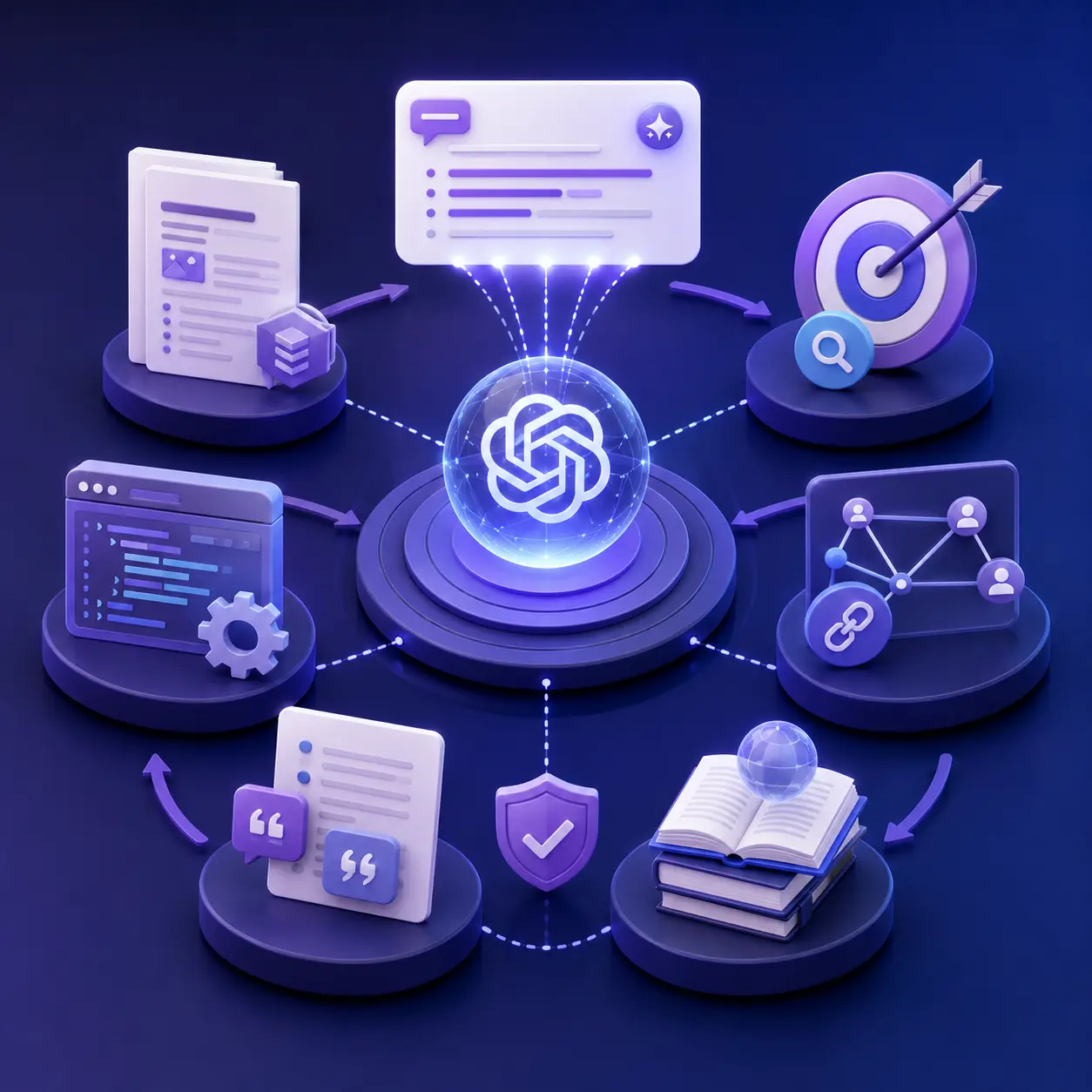
This is the framework. It's deliberately at the level of what and why, not how. For step-by-step execution, our guide on how to rank in ChatGPT is the tactical counterpart and goes considerably deeper on each of these.
1. Crawlability and index coverage
Nothing else matters if the assistant can't fetch you. This means OAI-SearchBot isn't blocked in robots.txt, your pages render server-side or close enough to it, and your important content isn't hidden behind interactions a crawler won't perform. It also means checking that you're actually present in the index ChatGPT retrieves from, which is a separate question from whether Google has you. Of the last eleven clients who came to us because ChatGPT was naming a competitor, nine had never checked whether OAI-SearchBot was allowed on their site. It's the cheapest thing on this list and the most common failure.
2. Answer-first page structure
State the answer in the opening two sentences, then explain. Not a preamble about how important the topic is, not a definition of a word your reader already knows. A model skimming your page for something to lift will take the passage that stands on its own out of context, so write passages that do. It's the change with the best return for the least effort on this whole list, and it costs nothing but discipline. It's also the backbone of answer engine optimisation generally.
3. Question-level content coverage
Because a broad question gets expanded into narrower searches, the pages that win are often the ones that answer the narrow versions. "Best web design agency in Vancouver" might fan out into questions about pricing, timelines, Webflow experience, and nonprofit work. If you've got a real page for each of those, you're in the pool several times over. If you've got one big page trying to cover all of it, you're competing on the broad phrasing the model may never actually search.
4. Entity consistency
Your business name, address, service list, and one-line description should be identical everywhere a model can read them: your site, your Google Business Profile, directories, LinkedIn, press, and any profile you've forgotten you made. Inconsistency doesn't just cost you accuracy, it costs you confidence. A model reconciling three different descriptions of your studio will often just name the competitor it can describe cleanly.
5. Third-party corroboration
This is the honest answer to "why does ChatGPT recommend my competitor and not me". It's usually not your website. It's that other sources the model already trusts describe them and don't mention you. Our 2026 Canadian AI search visibility benchmark found that nearly all brand mentions originated off the brand's own domain. Getting written about accurately by people who aren't you is slow, unglamorous, and the thing that actually moves the needle. One client, Strideform, went from being named in about one in ten of our tracked prompts to roughly four in ten over two quarters, almost entirely on the back of earned coverage.
6. Structured data and machine-readable signals
Schema that genuinely matches the page, particularly Organization, FAQPage, and Article. It won't make a mediocre page get cited, but it removes ambiguity about what you are and who wrote it. An llms.txt file sits in the same bucket: cheap to add, worth doing as future-proofing, and not something to expect results from on its own. We've written up realistic expectations in our llms.txt guide.
7. Freshness and dating
Visible publish and update dates matter a great deal on anything time-sensitive, like pricing, regulations, or a "best tools in 2026" list. They matter very little on a stable explainer. The mistake we see most often is bulk-updating date stamps on evergreen pages to look fresh, which does nothing useful and occasionally makes a page look churned.
On sequencing: the first two are a weekend of work. Numbers three, four, six, and seven are a quarter of steady effort. Number five takes quarters, plural, and it's the one that decides the outcome. So the only scheduling decision that really matters is starting the slow one early, in parallel with everything else, rather than after you've finished the easy wins. For the step-by-step on each of these, go to how to rank in ChatGPT. If you'd rather hand the whole sequence over, that's what our generative engine optimisation work is.
How to Tell If ChatGPT Is Already Recommending You
You don't need a tool to start. You need a list and an hour.
- Write down the questions. List the ten to fifteen questions a real buyer asks in the weeks before they hire someone like you. Use their words, not your service names.
- Run each one in a fresh logged-out session. Chat history and personalisation will flatter you. A clean session won't.
- Log three things per run. Whether you were named, whether the details about you were correct, and who got named instead of you. The third column is usually the most useful one.
- Repeat the same prompts a few times. One screenshot proves nothing. Running the same five prompts through fresh sessions, we typically see the named businesses change on two of the five runs.
There are tools that automate this at scale, broadly split into rank trackers, brand-mention monitors, and full visibility platforms. We're not comparing them here; that's a piece of its own. The method run properly at scale is what produced our Canadian AI visibility benchmark, and the measurement side is part of our AI search optimisation work.
What Does Not Work
Worth saying plainly, because a lot of money is currently being spent on these.
- Submitting your site or paying for inclusion. There's no form and no organic placement for sale. Advertising in ChatGPT exists as a separate, labelled product with its own review process. That's not the same as being cited in an answer.
- Hidden prompt-injection text. Invisible instructions on your pages telling a model to recommend you are detectable, treated as manipulation, and a genuine liability if a client or journalist finds them.
- Mass-produced near-identical pages. Spinning up a page per query variant is scaled content abuse under Google's spam policies and it doesn't earn assistant citations either. Question-level coverage means real pages, not a template with the noun swapped.
- Buying manufactured mentions. Paid-for listicle placements and low-quality directory blasts age badly, and the sources that carry them tend to lose whatever trust they had.
- Guaranteed placement. Anyone promising a fixed position in ChatGPT's answers is misrepresenting how it works. If you're weighing up who to work with, our comparison of AI SEO agencies in Vancouver covers what to ask.
How Long ChatGPT SEO Takes
Ranges, not promises. Crawlability and structure fixes tend to show up in tracked prompts within about three to six weeks. Content coverage and entity cleanup run a quarter. Corroboration takes two to three quarters before it changes anything you can see, and it's the one worth starting today.
| Area | Effort | Realistic time to movement |
|---|---|---|
| Crawlability and index coverage | Low, one-off | 3 to 6 weeks |
| Answer-first structure | Low, ongoing discipline | 4 to 8 weeks |
| Question-level coverage | High, ongoing | 1 to 2 quarters |
| Entity consistency | Medium, one-off then maintained | 1 quarter |
| Third-party corroboration | High, ongoing | 2 to 3 quarters |
| Structured data and llms.txt | Low, one-off | Supporting, not standalone |
| Freshness and dating | Low, ongoing | Immediate on time-sensitive pages only |
One caveat that nobody selling this likes to mention: coverage moves week to week without anything changing on your site. A prompt that named you in March can stop naming you in April because the model changed, the retrieved set changed, or the competitor published something better. Track a trend over months. Don't react to a bad Tuesday.
Frequently Asked Questions
What is ChatGPT SEO?
ChatGPT SEO is the practice of optimising your website and wider web presence so ChatGPT names, describes, and cites your business when someone asks it a question in your category. It covers crawlability, answer-first content, entity consistency, and third-party corroboration. It's also called generative engine optimisation or answer engine optimisation depending on who's describing it.
How do I get my business to show up in ChatGPT?
Start by making sure ChatGPT's search crawler isn't blocked and your pages are fetchable, then restructure your key pages to answer their question in the first two sentences. After that, the work is content that covers the narrow questions buyers actually ask, consistent business details everywhere online, and being described accurately by third-party sources. The last one takes longest and matters most.
Is ChatGPT SEO different from regular SEO?
About three quarters of it is ordinary technical and content SEO done more precisely, so you're not starting over. The difference is what you're optimising for: a named mention inside a written answer rather than a position in a list of links. The genuinely new work is entity consistency and third-party corroboration.
Can you pay to appear in ChatGPT?
Not for organic answers. There's no submission form, no index to apply to, and no paid placement inside the cited sources of a normal response. Advertising in ChatGPT exists as a separate labelled product, and any agency guaranteeing you a spot in organic answers is misrepresenting how the system works.
How long does it take to show up in ChatGPT?
Crawlability and structure fixes usually show up in tracked prompts within three to six weeks. Content and entity work runs about a quarter. Earning third-party corroboration takes two to three quarters, and coverage fluctuates week to week regardless, so judge it on a trend over months rather than a single check.
So: ChatGPT SEO is getting an assistant to name and describe your business accurately when someone asks it a question in your category. Seven areas move it, and they're crawlability, answer-first structure, question-level coverage, entity consistency, third-party corroboration, structured data, and sensible dating. Most of that is SEO done properly. The new part is being described accurately by other people, and that part can't be rushed. Given that OpenAI put ChatGPT at 900 million weekly active users in February 2026, the cost of being the business the assistant can't describe cleanly is only going one way. If you want the technical groundwork handled alongside the rest, that sits inside our SEO and AI visibility service.
Parabolic Studio helps Vancouver and BC businesses get named across ChatGPT, Perplexity, Gemini, and Google AI Overviews. If you'd like to see the method run at scale first, read the 2026 Canadian AI Search Visibility Benchmark.